![Fundmore-Logo.png]](https://help.fundmore.ai/hs-fs/hubfs/Fundmore-Logo.png?height=50&name=Fundmore-Logo.png)
Table Of Contents
Introduction
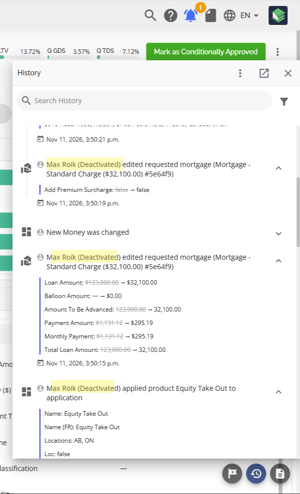
The Application History keeps the user informed about all developments pertaining to their application. We provide an intuitive interface that enables users to view, search, filter and export the comprehensive application history. This feature records all actions taken within the application, including the type of action, who performed it, timestamp, and any resultant changes in the application stage.
Note: An "Application Ratios were Changed" log entry may appear without identifying the user who performed the action, as there isn't always a specific trigger for this entry. This is expected behaviour. This may occur, for instance, when the application is launched, or it could be a recalculation prompted by a background change.

To access the Application History, click on the ‘Application History’ icon, located to the left of the Notes icon at the bottom-right corner of the application dashboard. The History Log presents activities in chronological order, with the most recent entries appearing first, followed by the oldest ones. The history log entries incorporate notes, as it was designed to appear conversational.
View History
You can view the application history through a pop-up window within the application. This pop-up provides all the functionalities you need, in a compact view. You can navigate through entries, conduct searches, apply filters, and expand or collapse specific entries as needed.
To expand or collapse an entry, click on the arrow beside the date.

There is an option to maximize the pop-up window of the history log. Simply click on the ‘maximize’ icon as seen in the image below.

Searching For History Entries
Users can search the history log for a specific entry using information, such as a text field, a value, an address, or any other deal-related details. To do so, simply start entering your search criteria in the search bar. You will see that the history module starts populating with any entries that contain your search criteria.

Filtering For History Entries
The application history can be filtered by date range, category, or user, with the flexibility to choose single or multiple selections among these options. As you apply these filters, the history module will dynamically update to display the relevant information.

Date Range - Input a single date or specify a start date and an end date for the period of time you wish to filter by.
Categories - There are currently 12 categories you can filter by: Application, Approvals, Conditions, Credit, Documents, Income, Loan Details, Net Worth, Note, Property, Stakeholder, & Task. Choose one or multiple options.
Users - A drop down list of all users in the system. Choose one or multiple options.
Note: When a user is deactivated or deleted, their name still shows in Application History, with a note of “(Deactivated)” or “(Deleted)” beside their name.
Export as PDF
You can generate a PDF document containing the application history. This allows lenders to distribute the history logs to various stakeholders, while safeguarding the file’s accessibility from external parties. To do this, click on the ellipsis and select Export as pdf.

The system will provide you with a PDF download that you can print or email as you need.

When you open the PDF document, you will see the all history entries for the application in order and the document will be titled Application History with the date of the download, the borrower(s) name, loan number, and property address.

Please note that your exported history will reflect any filters applied. Therefore, if your history logs span the last 12 months but you have filtered for the past 30 days, your export will exclusively display data from the last 30 days.